March 21st, 2012 — 5:30am
A business coach asked me a tough question the other day. I think it brings up one of the most important lessons I could learn at this point in my leadership career.
He asked, “Are you doing this because it’s best for your business, or because you want to be right?”
I like being right, and I hate being wrong, so that question was hard for me to digest. My thoughts ran forward to how much damage I might do to my lifetime impact potential. What if I don’t have the maturity to do the wise thing even when it means being wrong in my eyes or someone else’s? The foolish choices I could make in the name of being right scare me.
Leaders need to be resilient. Part of that is having the security to admit a wrong, or tolerate being called wrong, and not let that interfere with wise decision-making.
I’m really thankful he asked me that tough question.
March 14th, 2012 — 5:30am
I think of organizational culture as “how we do things here”. It includes what is praised here, what is frowned upon, and what will get someone fired. Different cultural styles exist, from expertise-oriented, to inclusion-oriented. One style is not necessarily superior to another, but it’s important that everyone in the organization be aligned.
When cultural alignment problems exist, two things need to happen:
1. The leader needs to clearly communicate in words and by example “how we do things here”.
2. Team members who are unwilling or unable to align with the desired culture must be replaced.
If you want a high-energy, can-do culture and you have a low-stress, enjoy-the-process team member, it’s probably not going to work.
There is no such thing as culture change without turnover.
Of course the logical thing to do going forward is purposefully select employees who fit the desired culture at hiring time.
March 7th, 2012 — 5:30am
I’ve been back in the USA for three days now. It’s great to be back home.
My American friends, I want to challenge how you think about distant countries like India.
Value the Differences
Realize that there are good reasons for the strange customs, the strange food, the strange family culture. Do not assume that different equals inferior. In most cases the American way is not better, it’s just suited for a different context. In most cases our way wouldn’t work as well there as their way does. America is great at a lot of things, but not everything is better here.
See the Commonality
Some of the circumstances are different, but people everywhere have ambition to better themselves, loyalty to family and friends, desire for meaningful work, struggles with insecurity, and pain in difficult relationships. Human emotion and human psychology are pretty universal.
Care Across Borders
Do you see yourself on the same team with your fellow citizens of earth in all countries, or do you see opposing teams? Are you willing to give up some prosperity if it means more people across the globe can lift themselves out of poverty? Are you willing to send aid money to places in need? Are you willing to send outsourced jobs to places in need? Isn’t a job better than a handout?
Do you love people because they are from your country, because they are like you, or because they are inherently valuable humans?
March 1st, 2012 — 10:11pm
I’m watching daybreak in Kolkata for the last time on this trip. My mind and heart are full of everything I have seen and felt in the last four days.
I thought by now I’d be aching to go home, yearning for familiar comforts, and disturbed by the brokenness of this place. I feel an ache, but it’s one of sadness at leaving this place that embraced me wholeheartedly and gave me new friends. I feel a yearning to look into the face of every man, woman, and child here and inspire them to believe their own life is of infinite value. And although I see the brokenness here, as I leave I am disturbed by what is missing in America.
I thought I would pity the people here, but I don’t. They don’t need or want my pity. They want opportunity. They want freedom from corruption. They want to better themselves. They want human connection and they have it in spades.
Kolkata is a beehive overflowing with buzzing humanity. By contrast America now seems sterile, cold, and isolated. Here even driving down the road is an interactive experience full of humanity. Take the buses for example, jammed full plus a dozen people on the roof all chattering, laughing, leaning out the windows, jumping on and off as they lurch along. Or the constant blaring of horns which seems like futile insanity until you being to understand that most of it is caring signaling for the safety of pedestrians, carts, and bicycles engaged in the high stakes weaving dance of jockeying for space on the narrow road ahead.
In America we sit alone in our separate cars, staring straight ahead, barely acknowledging the fellow members of humanity we are passing. If you’ve never been swept away by a place like this I probably sound crazy to you, but right now it’s the American version of driving that makes no sense to me.
I came here hoping I could give the people of Kolkata something of what I’ve been blessed with. I didn’t expect to receive so much of what they have been blessed with. I’m leaving here with a bigger heart more deeply in love with the beauty of humanity.
February 29th, 2012 — 6:17pm
Yesterday I spent 9 hours on a trip to visit a textile dye house. About 8 hours of that we spent driving the 40 miles there and back. Traffic is beyond insane here in this overcrowded city. In conversing with my suppliers and so much to see as we drove, the time flew by.
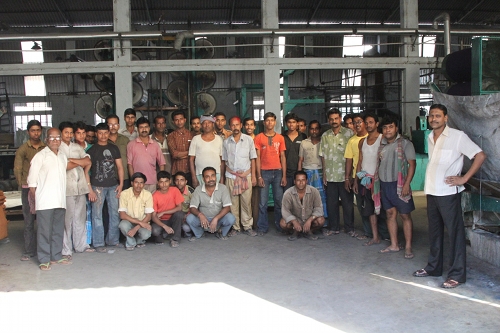
The dye house crew. I did my best to communicate my gratitude to these workers for their contribution to my business in America.
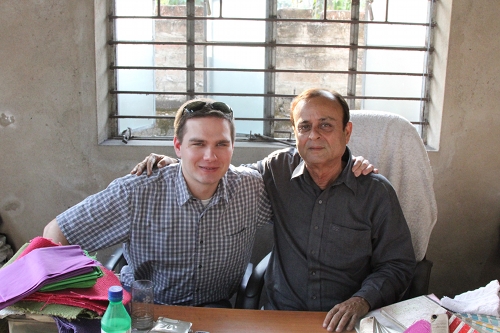
Me with the owner of the dye house. He had just been telling me about how he likes Covey's Seven Habits book. Amazing what we have in common with people seemingly far removed.

As I adjust to the newness of this place, the sights and sounds are fading into the background and the people are capturing my attention.