I read an article in the latest issue of Harvard Business Review about a study done on business strategies during the last three recessions. The goal was determine the most effective strategy a business can take during a downturn, measured by growth and profits in the three years after the downturn ended.
Here are my thoughts and observation after reading the article, colored by my experience and business philosophy.
Even the best businesses feel the pain. Recessions hit both strong and weak businesses hard.
Going into the fetal position is the worst strategy. Companies that do large layoffs and big cuts to development and investment budgets fare the worst. A highly defensive strategy is suicidal.
Going super-aggressive is not effective either. Desperately reinventing everything doesn’t turn out well during recessions or any other time.
Steady, future-minded investment with an extra dose of proactivity is the best strategy during a recession. Companies that invested for the future and didn’t do large layoffs were in the best position to grow during the economic recovery.
My overall takeaway is this: The same measured, proactive strategies that work best during good times work best during hard times too.
Don’t panic or veer off in untested directions.
Don’t lay off key people you will need during the recovery.
Do continue to invest in the company’s future, facilities, and R & D.
Do make extra effort to be proactive and open to cautious, tested changes.
These strategies will not spare a company from the pain of the recession, but they will move them ahead of the competition during the economic recovery that follows.
I have often observed that good old-fashioned business strategy holds up better than the latest wisdom about how “everything is different now”. Recessions are no exception.
If I started a $1 million factory building project, and I had only $1,000 of work left to do on it when I found out the factory was sure to lose money, should I spend the money to finish it?
Instinct says that $1,000 is a lot less than $1 million and you hate to see that $999,000 go to waste. But the truth is, if I know the factory will lose money and I spend the $1,000 then that’s $1,000 more gone to waste. In this scenario, the $999,000 is called a sunk cost.
I did one of these irrational sunk cost deals last time I was in Dallas Fort-Worth airport. It’s a big place and you are supposed to take a little train to get around quickly. I rushed over and took the long, high escalator to what I thought was the train depot level, and realized I had accidentally taken the escalator to the pedestrian walking bridge instead. It was a long way to walk and I was short on time, but in my hurry and stubborn style I walked all the way across to the other terminal. It would have taken 30 seconds to simply ride an escalator back down and get back on the right track. But I didn’t want the reverse and the restart. Going forward felt better.
The purely rational way to evaluate these situations is to compare the future outcome of option A with the future outcome of option B. Whatever will produce the best future outcome, go with it. The past can’t be changed by the current decision, and must be accepted for the now-unavoidable loss that it is. Decisions should be based on how they will affect the future. Present decisions don’t change the past.
Sometimes the cost of indulging the straightforward, reversal-free choice is just a few minutes of time or some other price tag small enough to ignore. But when a lot is at stake, don’t let sunk costs cloud your judgment. It takes sober awareness of the numbers, courage, and humility. Sometimes you just have to admit a big mistake and turn the ship around.
In posts like my last one, The Marshmallow Experiment, on delay of gratification, I kinda sound like someone who thinks change and success are all about willpower. Well, they’re not.
I think willpower is totally overrated. I guess where there’s a will there’s a way, but willpower is not the way part, it’s just the will part.
Some problems are solved by getting information that was missing, or by persevering with what we are already doing. I like these problems. They are so easy because they don’t require a change in who we are. Most of the problems we have aren’t this kind, because these have such a short half-life. They don’t last long.
The problems that remain are the tougher sort. These are the problems that stick around after willpower has been applied. I have an observation about this. If you don’t have enough willpower to make the change or solve the problem then I think (and this is deep) you don’t have enough willpower to make the change or solve the problem.
You’re going to need something else, something more than willpower, something you don’t already have in you, something from the outside, something you can’t decide, something you have to experience and receive from other people.
You can’t willpower your way to self-discipline, you have to experience and receive discipline from other people.
You can’t willpower your way out of loneliness, you have to experience and receive connection from other people.
You can’t willpower your way to confidence, you have to experience and receive acceptance from other people.
You can’t willpower your way to new job skills, you have to experience and receive training from other people.
You can’t willpower your way out of burnout, you have to experience and receive help from other people.
I think willpower is denial in a thin disguise. It’s denial with a time element. Regular denial says “I didn’t fall” while lying flat on the ground. Obviously foolish. Willpower-flavored denial says “I won’t fall next time” even though nothing has changed. Not as obvious, but just as foolish.
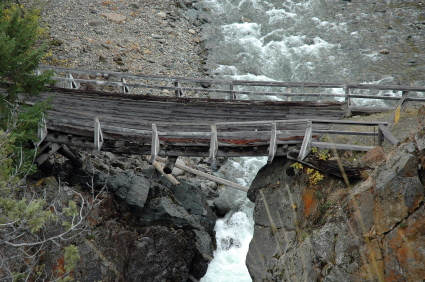
The canyon between knowing and doing is not bridged by willpower alone. When the willpower bridge collapses and you find yourself making a hard landing in the bottom of the canyon, that’s not your reminder to try harder, that’s your reminder to get people. You don’t have the power to jump the canyon but you do have the power to drag your scraped-up self to a coach, a group, a teacher, or a friend. They don’t help build a bridge, they help fill in the canyon.
Delay of gratification has got to be one of the most valuable abilities in life. It’s all about making difficult choices now with the best long-term outcome in mind. (See my earlier post, Make Room for the Long Term.)
In the 1960’s a group of researches at Stanford conducted a now famous experiment that captures this struggle. Kids were given a marshmallow and told that if they waited 20 minutes to eat it, they would get two marshmallows instead. Someone did a re-creation of the experiment and put it on YouTube.
The Stanford researchers tested 4 year olds, then tracked their success for 18 years. Kids that waited longer to eat the marshmallow did better in school and in relationships. This one character ability was a significant predictor of success.
I’m pretty sure I would have eaten the marshmallow.
We are born with brains that aren’t very good at grasping time. The here and now looms large. The ability to delay gratification is learned by growing up in a world where actions lead to consequences in a consistent, predictable pattern.
I want to be more aware of the countless times per day I am faced with marshmallow-like choices in life and in business. Whether or not to refund an unhappy customer. What and how much to eat for lunch. Whether or not to confront unacceptable behavior. When to buy and sell investments. How much time to spend with my kids. How to use credit cards and savings accounts. All of these have a delay-of-gratification element. Sometimes I feel just like one of those kids in the video.
I watched Evan Lysacek win men’s figure skating gold last night. His coach said he trained harder than any figure skater he’s ever known. I saw him stand on the podium holding that gold medal and smiling like the happiest person on earth. It was on TV, I didn’t have to envision it. But he had to envision it a long time ago, when it was a distant and uncertain possibility. He made a million choices to do difficult things every day to move a little closer to making that vision real. He gets this.
The long-term is real. It’s coming, and you are shaping it every day. Zoom out as much as you can and look at the big, long-term picture when you make choices. Look beyond what you see now and envision the end of the story.
I was watching the Winter Olympics last night. I observed each skater having a quick conversation with his coach before gliding out onto the Olympic stage. While executing one of the most important performances of his career, each skater had the final words of his coach ringing in his ears. I didn’t see anyone skating without a coach.
We all know it’s impossible to achieve legendary athletic success without a coach. Athletes need the greater experience, outside perspective, motivation, and relational support a coach provides. Someone who’s been there, who can see what the athlete can’t, can push him to do more than he thought possible, and is there with him through the ups and downs. As I watched, it just seemed natural and obvious that every athlete would have a coach by his side.
I think we all need coaches in the rest of life too. Outside of sports we might call them business coaches, counselors, therapists, support groups, advisory boards, or life coaches. From sports to business to relationships, I think success and coaching go hand in hand.
I “skated without a coach” so to speak for my first five years as an entrepreneur. I had a lot of success, but I was limited in several areas by lack of experience or personal hangups. I paid a price in dollars and in stress for those areas where I needed to grow.
In 2009 I took part in a monthly leadership coaching program and also started bi-weekly sessions with a one-on-one counselor. Both have been incredibly helpful. I’ve grown and overcome personal obstacles much more quickly than I did on my own. I plan to continue with both of these coaches through 2010. I don’t think I will ever go without a coach again.
Who is coaching you in the areas you want to grow and succeed?
P.S. Coaches don’t seek you out. It’s your responsibility to find them and hire them. It takes energy, courage, and usually money. It’s worth it.