
Author Archive


The Angst of the Dip

June 8th, 2010 — 11:07am

Recently I wrote about “The Dip” by Seth Godin. It’s a book about how every project goes through a dip, a time of being difficult and uncertain. We have to choose which projects to push through, and which to wisely abandon.

I am experiencing one of those dips up and close and personal right now. When I got my iPad I got pretty infatuated with it and I decided, that’s it, I gotta learn how to wrote apps for these things. So I bought a couple of books on learning the technology, and I spent the money to get a mac computer, required for the development process.

I dove into all the learning curves and had a fantastic, nerdy time figuring it all out. I decided to write a personal time tracking application as my learning project, with a belief that it would be useful and marketable as well. The coaching program I’m in assigns all new members to track everything they do with their time for a week and this app would make that task much easier. So I know at least a few people could use it.

I put the first test version of that app onto my own iPhone yesterday. Then the doubt set in. It’s cool. But is it really marketable? Will I ever sell enough copies to pay for the books I bought (let alone the mac I bought)? There are a few other apps on the app store that do similar things already. Can my approach to time analysis offer a significant advantage? Maybe I just got excited because I’m a nerd about technology stuff, and there’s no real payoff but fun and learning for me. Deep down, I’m probably most afraid of embarrassing myself by getting irrationally excited about something that doesn’t have any real potential.

There it is. The dip, with all its doubts. And the doubts may very well be right.

On the other hand, the app might be really useful to people who are looking to get a handle on their time. If people find it helpful, it might sell enough to make my nerdy learning project profitable, not just fun. I’ve felt the pressure of the dip on every endeavor I’ve tried before. Some of them failed, some of them succeeded in big ways. What to do, what to do.

My advice (to myself and anyone else feeling the agnst of the dip):

First, resist the fear of embarrassing failure as much as you can. It’s a strong instinct, but not actually dangerous.

Second:

  • if there is any reasonable chance of a worthwhile result,
  • and if the worst-case downside is an acceptable risk (i.e. it won’t bankrupt you if it fails)
  • and if the project does not take you away from something else with clearly superior potential,
  • then, pursue the project in the smallest-scale way that will get you to proof-of-concept.

I’ll let you know in a few weeks if I was brave enough (or maybe foolish enough) to follow my own advice.
The Extrapolation Assumption

June 7th, 2010 — 10:10am

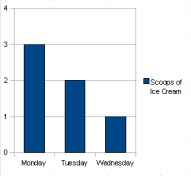
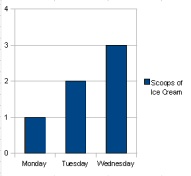
Which would you rather have: 3 scoops of ice cream on Monday, 2 scoops on Tuesday, and 1 scoop on Wednesday, or the reverse, 1 scoop on Monday, 2 scoops on Tuesday, and 3 scoops on Wednesday?

Researchers who study intertemporal decision making (decisions involving a span of time) find that most people prefer the second case, with ascending rewards. Interestingly, this is not the purely rational choice. Receiving the extra ice cream earlier is slightly superior if the goal is maximum benefit, because there is some risk of interruption in the plan before Wednesday. For example, I could get hit by a bus, get sick, the ice cream supply could run out, etc.

One reason for our tendency to choose the ascending sequence is that we prefer to look forward to things getting better rather than dread things getting worse. (I know, dread is a strong word for ice cream, but I can’t think of a word that means mild dread. Word lovers, leave me a comment.)

But another reason for our irrational choice, one I didn’t guess, is that we tend to automatically and subconsciously extrapolate the trend into the future. We include in our mental calculation some assumption that we might get 4 scoops on Thursday in the ascending sequence, and 0 scoops on Thursday in the descending sequence.

I suppose this mental habit is often useful, since many trends do continue into the future. But this mental habit of making decisions based on the assumption that the observed trend will continue also leads to things like economy-destabilizing housing bubbles and bad business decisions. When data is available to rationally evaluate the probability that the trend will continue, be aware of the subconscious tendency to assume, and take a look at the data.

To Do More Than Survive

May 24th, 2010 — 8:42am

People, including potential customers, are more motivated to avoid loss than to pursue gain. Fear is stronger than greed.

We also tend to perceive taking action as more risky than not taking action.

These are probably good ways to stay alive if you are a creature trying to avoid being eaten by a predator. They are survival instincts.

So what if you are trying to motivate yourself or someone else to do more than survive, to take action with a potential loss involved?

One way might be to work with this natural fear of loss, by creating an awareness of the potential losses involved in not taking action (not leading, not starting, not purchasing).

Here’s the reality. Inactivity is more risky than activity for humans who aim to do more than survive. And we have more to gain than we have to lose, so in the grand scheme of things potential gain is greater than potential loss. (This is only true of anyone who currently possesses less than half of all the good things on earth.)

In living and in selling, it’s worth balancing these common illusions with some reality from the other side.    

What I Think About Leadership

May 21st, 2010 — 5:00am

Leadership is having the courage to step out and be in front without permission from everyone or assurance from anyone that everything is going to be ok.

Leadership is valuing people, truth, and results highly enough to say and do uncomfortable things, knowing in advance those things will create conflict.

Stepping out in front is an essential act of leadership, but only when people actually follow does the one in front become a leader.

By directing people and resources toward a common goal, leaders accomplish things that would not otherwise have been accomplished, even though all the people and resources needed were already present before the leader led.

Nothing too big for one person to do alone can be accomplished without leadership, and thus leadership is of great interest to all who dream big.

Granularity

May 20th, 2010 — 5:25am

A lot of information is lost when data are aggregated into averages and statistics. For example, the best books often get mediocre 2.5 star average reviews on Amazon. Why? That statistic conceals the reality that nobody is giving the book a 2.5 star rating, they either love it and give it a 5 or hate it and give it a 1. The statistic says apathy, the granular data says controversy.

Considering data at a more granular level uncovers meaningful variations that cancel each other out at the aggregate level.

For example, web site stats are useful, but I also like to look at the path an individual visitor took through our web site. This granular look often suggests areas of confusion, or sometimes draws my attention to weaker parts of the site that can use work.

Another application of this idea is to use itemization to stimulate creativity. For example I recently broke the pre-sale customer experience at one of my companies into about twenty distinct steps. I brainstormed how we might improve each step, even the ones that don’t normally seem the most important.

Give yourself the mental limitation of considering only one part of the whole at a time to encourage new combinations of non-obvious ideas.

Back to top