Author Archive


Unfair Advantages

May 17th, 2010 — 1:28pm

The three most important questions I ask myself when tossing a new business idea around in my head are:

  1. Will the potential customers find the product or service really helpful?
  2. Can we do such a good job providing it that the potential customers find it more helpful than their other options?
  3. Can we inform potential customers about our helpful product or service in a cost-effective way?

This post relates to question #2. Since there is so much competition out there, it helps a great deal to have some unfair advantages, especially in the early years of a startup.

By unfair advantages I mean existing core competencies, relationships with key people in the market, synergies with other businesses, etc. Why compete on a level playing field when you can compete on the part of the field where you have the biggest advantages?

Here’s a personal example. When we started ATS Rentals, a nationwide online audio, video, and projection equipment rental company, we had the following unfair advantages:

  • I had previous college work and job experience in a/v and broadcasting technology. I could do my own equipment repairs during the startup phase.
  • My most senior employee at my existing business had a degree in video and film production, and tons of gear knowledge.
  • I had experience from a previous business of mine that specialized in e-commerce web site development. I could develop the software to run the web site, booking, and shipping system for just the cost of my time.
  • We had an existing customer service staff, warehouse, and shipping infrastructure in place that we could share with the new startup. We had everything in place to test-market the concept without hiring a single employee or building out any facilities.
  • I had my own capital to fund the startup, avoiding the cost of obtaining financing and carrying the insurance, etc that would be required by the bank or investors.

My point is not that I or my companies are special. My point is I picked a business that fit what we had and were good at, so we would be starting with some unfair advantages.

You have unfair advantages too. Everyone does. I encourage you to know what they are and work them into your plans. Be unfair to your competition on purpose.
The Pace of Change

May 14th, 2010 — 5:00am

Five months ago I bought a Kindle. It was novel and fun. People next to me on airplanes asked about it because they hadn’t seen one before. I read lots of books with it and I loved it.

I received my iPad yesterday. Within three hours I put my Kindle up for sale on eBay. Here’s the link. Amazon makes a free Kindle app for the iPad, giving me access to all my Kindle books on my new device. And the iPad can do a zillion things my Kindle can’t. (I’m writing this on my iPad.)

I have never felt the pace of change so whiplash fast before. What a challenge for technology companies, and for all of us, to succeed in a world of change at breakneck speed. I actually feel bad for Amazon and Jeff Bezos today. I think Kindle took longer to develop than it took to get seriously trumped. But the iPad will be trumped soon enough too. There is no pause button on this race.

I believe in accepting reality. Reality is, the pace of technological and economic change is faster than ever and it’s only going to get faster still.

To some degree this reality re-sorts the skills needed to succeed. Willingness to risk, to fail, to change on purpose, to end things and start new ones are all valuable skills in a change-dominated economy.

Change is scary. I think there are rewards to those leaders who embrace the pace in spite of the fear.

Zoom Out

May 13th, 2010 — 6:00am

To make wise decisions as a leader you must zoom out and view the big picture. Here are three types of bigger picture to keep in mind.

  1. Zoom out from ideas to emotions. Be aware of feelings (yours and others) that affect the situation.
  2. Zoom out from accounting cost to opportunity cost. Accounting cost is the direct cost of choosing a particular course of action. Opportunity cost is the value you are giving up in the best course of action you chose not to take.
  3. Zoom out from the present to the long term. Henry Cloud says “play the whole movie”. Stephen Covey says “begin with the end in mind”. Don’t just look at what will happen tomorrow or next quarter if you choose A vs. B. Look at what will happen all the way down the line.

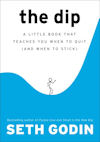
The Dip by Seth Godin, a book worth reading.

May 12th, 2010 — 7:00am

The Dip by Seth GodinThis book is about perseverance, and quitting. Everything worth doing goes through a “dip” of being difficult, during which perseverance is required. But, some things not worth doing also go through a dip, and some things not worth doing aren’t even difficult at all. So this book is about the virtue of perseverance when it’s worth it, and the virtue of quitting when it’s not. It takes a stab at the question of how to tell the difference. It’s really all about the long term.

It’s a quick read and it will probably make you think about what you should quit and what you might gain by starting something difficult. I recommend it.

P.S. Seth Godin is taking a speaking road trip this summer. I’ll be attending his Chicago stop on September 16th. If you’re going let me know so we can hang out.

Trading Up

May 9th, 2010 — 4:04pm

I’ve been thinking over Jesus’ story of the shrewd manager in Luke chapter 16, and talking to friends about it. I think that story means something worth sharing:

The most basic resources we have are time and energy. These are the cards we hold in our hand at the beginning of the game. Life is a constant barrage of opportunities and choices about what we will trade our time and energy for. We can work an hourly job, trading for money. We can spend our time and energy talking to someone, trading for relationship. Very often we trade money for many other things we need and want.

Most of us will have over 600,000 hours of time and energy in our lives. We will choose to trade every one of them for something. And what we receive for those trades, (money, possessions, knowledge, etc.) we can go on to trade again for something else. We are all constant traders on the giant eBay of life.

One of life’s great, redemptive realities is the universal opportunity and freedom to trade what we have for what we value more. We are not confined to merely trading money for money, or stuff for stuff. We have the opportunity to trade up. We can trade for smiles, for learning, for friendship, for love, for worship, for things of greater and longer-lasting value than the time or money it cost us. Given the compounding effect of day after day of trading up, what an incredible and powerful opportunity a lifetime of trades is.

Last night my wife and I had a wonderful dinner at a great restaurant with new friends. We traded time and money for the treasures of conversation and relationship.

Each month I spend three days, tuition, and travel to attend a leadership coaching program, trading for the treasure of personal character growth.

Too often I trade my time and money for things of little to no value at all.

So what do you value more than the time, energy, and money you currently have available to trade? What will you trade for today? At the end of your life, after all your trades are done, what will you have transformed your lifetime of time and energy into? What do you want to be holding in your hand at the end?

Back to top